Breathwork has one of the widest gaps in wellness between marketing and evidence. A few specific protocols have real acute effect sizes; most generic "deep breathing" recommendations don't.
What actually works, ranked
Physiological sigh , best acute evidence
Balban 2023 (Cell Reports Medicine, n=108) randomized healthy adults to 5 min/day of physiological sigh, box breathing, cyclic hyperventilation, or mindfulness meditation for 28 days ( Balban et al. 2023, n=108 ). The physiological sigh group showed the largest improvement in daily positive affect and largest reduction in respiratory rate at rest. Effect sizes modest but clear directional separation from the other arms.
Technique: Double inhale through the nose (one long, one short), long exhale through the mouth. 3-5 cycles repeat for 1-5 minutes. Works acutely for stress down-regulation.
Slow breathing (~6 breaths/min) , best chronic evidence
Zaccaro 2018 (Frontiers in Human Neuroscience) systematic review covered slow-breathing protocols broadly ( Zaccaro et al. 2018 ). Consistent finding across modalities: breathing at ~6 breaths/min (4-6 second inhale, 6-8 second exhale) raises heart rate variability during and after practice, and shifts autonomic balance toward parasympathetic.
Technique: 4 seconds in, hold 1-2 seconds, 6 seconds out. 5-10 minutes daily. Measurable HRV effect accumulates over 4-6 weeks.
Box breathing (4-4-4-4)
Less RCT data than physiological sigh or slow breathing. Useful as an acute tool for stress regulation (used by military and first responders). Probably works via the same slow-breathing mechanism. 4 seconds in, 4-second hold, 4 seconds out, 4-second hold, repeat 4-8 rounds.
4-7-8 breathing
Popularized by Andrew Weil as a sleep-onset tool. 4-second inhale, 7-second hold, 8-second exhale. Thin RCT data; anecdotally helpful for some at bedtime. The long hold + exaggerated exhale are slow-breathing territory (below 4 breaths/min), so the mechanism is probably similar.
Wim Hof method
30-40 cyclic hyperventilation breaths followed by breath-hold. Kox 2014 (PNAS, n=24) found the WHM + cold attenuated inflammatory response to endotoxin injection. Small trial. Subsequent literature on mood or broad health is sparse. Useful for cold-tolerance training (paired with Wim Hof cold protocols); broader "immune enhancement" claims are oversold.
Protocol

| Phase | Dose | Frequency | Notes |
|---|---|---|---|
| Acute stress down-regulation | Physiological sigh, 1-5 min | as needed | Most compact effective acute tool |
| Long-term HRV building | Slow breathing (~6 bpm), 10 min | daily, 4+ weeks | Measurable HRV change after 4-6 weeks |
| Sleep onset | 4-7-8, 4 cycles | at bedtime | Try for 2 weeks; stop if no effect |
| Cold training | Wim Hof rounds | pre-cold exposure | Legitimate for cold tolerance; not a standalone health tool |
| Meditation adjunct | Any slow-breathing protocol | during meditation | Slows the respiratory rate that most meditation traditions target anyway |
Safety
- Breath-holds (Wim Hof, hyperventilation rounds): never in water or while driving. Syncope risk.
- Pregnant or cardiovascular-unstable: skip hyperventilation-forward protocols.
- Panic-disorder patients: slow breathing can backfire on some. Start cautious and supervised.
Mechanism: why slow exhale does the work
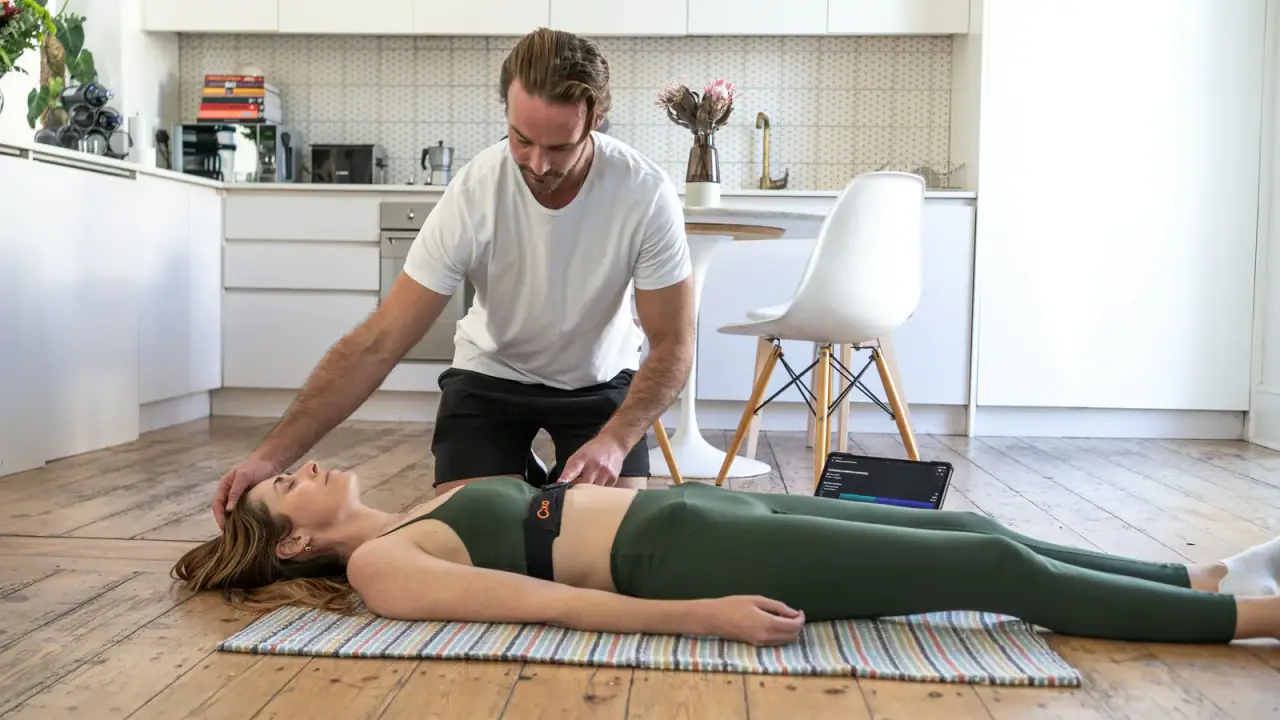
Most of breathwork's autonomic effect comes from the exhale, not the inhale. The mechanism is mechanical and well-characterized:
Vagal tone via heart-rate baroreflex. Each exhale activates pulmonary stretch receptors and baroreceptors that signal the vagus nerve, producing a brief parasympathetic surge. Slow, prolonged exhales amplify the vagal pulse. This is why protocols emphasize the "longer out than in" pattern: a 4-second inhale followed by a 6-8-second exhale produces measurably more parasympathetic activation than equal-duration breathing.
Respiratory sinus arrhythmia (RSA) coupling. Heart rate naturally accelerates on inhale and decelerates on exhale. The amplitude of this oscillation (RSA) correlates with vagal tone and is the dominant contributor to short-term HRV. Slow breathing at ~6 breaths/min hits the resonance frequency of the baroreflex loop, maximizing RSA and HRV during practice.
CO2 chemoreceptor sensitivity. Slow breathing mildly elevates blood CO2, which feels uncomfortable until the body adapts. Chronic practice (4-6 weeks at 10 min/day) gradually shifts CO2 tolerance, which is why many practitioners report less anxiety, better sleep, and slower resting respiratory rate after sustained practice rather than from any single session.
The physiological sigh works through a different pathway: the double inhale recruits collapsed alveoli (improving gas exchange acutely) and the long exhale activates the same baroreflex loop. The acute mood effect is faster than slow breathing because the alveolar recruitment produces a measurable shift in arterial CO2 within seconds rather than minutes.
The takeaway: extend the exhale, slow the rate, and the autonomic effect is mechanical rather than mystical.
Where breathwork doesn't work
Three categories where the marketing oversells the evidence:
Aerobic capacity gains from "breath training." The Patrick McKeown / Buteyko literature claims that nasal-only breathing during exercise improves VO2 max. The actual VO2 max-changing intervention is endurance training, not breathing modality. Some efficiency gains from nasal breathing during low-intensity aerobic work are real (lower respiratory rate at matched workload), but the headline VO2 max claims aren't supported.
Inflammatory disease reversal. The Kox 2014 endotoxin trial established a small immunomodulatory signal from the Wim Hof method in healthy young adults responding to a single inflammatory challenge. The extrapolation to "breathwork cures autoimmune disease" is unsupported by trial evidence. The mechanistic plausibility doesn't translate into a clinical-outcome signal.
Cognitive enhancement. Some breathwork protocols claim acute focus or memory gains. The acute mood and arousal data is real; the cognitive-performance translation is thin. Most studies that show "breathing improves cognition" are confounded by stress reduction (less anxious participants test better), which is a real effect but a different mechanism than direct cognitive enhancement.
Lung capacity expansion in adults. Lung capacity is largely fixed in adults absent disease. Breath training can improve respiratory muscle strength (which feels like more capacity) but doesn't expand the alveolar surface area or change the FEV1/FVC ratio in healthy adults. The "breathwork increases lung capacity" claim is mostly metaphorical.
The honest framing: breathwork is an autonomic-state-shifting tool, not a metabolic, immune, or cognitive enhancer in any robust sense. Use it for what it does well.
Stacking with other interventions

Breathwork composes well with several other interventions because the autonomic mechanism is general:
Pre-meditation. 5 minutes of slow breathing before sitting reduces sympathetic arousal and shortens time-to-meditation-state. Most meditation traditions implicitly do this; making it explicit is a small efficiency gain.
Pre-sleep. 4-7-8 or slow breathing at the threshold of falling asleep activates parasympathetic tone and reduces sleep-onset latency. Combine with the sleep-stack supplements; the autonomic shift adds to the chemical signal.
Pre-cold-exposure. Wim Hof rounds before a cold plunge raise stress tolerance and slightly attenuate the cold shock response. This is the legitimate pairing for the Wim Hof method.
Pre-public-speaking or pre-difficult-conversation. Physiological sigh in the bathroom 5 minutes before a high-stakes conversation reduces voice tremor and resting heart rate. The acute use case where the effect size is largest.
Anti-stack: post-caffeine. Slow breathing immediately after a high-caffeine dose can produce a paradoxical anxiety spike in some users via the chemoreceptor pathway. Wait 60-90 minutes after caffeine if you're sensitive.
The stacking principle is the same as everywhere else: pick the modality that targets the specific phase of the activity you're optimizing, and don't expect breathwork to substitute for the underlying intervention it's adjuncting.
Counter-view
Andrew Huberman is more enthusiastic about specific protocols (physiological sigh + slow breathing) than the evidence strictly supports for broader health outcomes; his acute-tool framing is appropriate but downstream chronic-health claims run ahead of the data. The skeptical camp (Scott Alexander) argues most breathwork evidence is small-sample unblinded and that a large fraction is placebo + demand characteristics. Both have points. The safe bet is physiological sigh for acute use and slow breathing for HRV work, and holding loose priors on the chronic health claims.