
The supplement-stack-for-sleep market is full of products that overdose melatonin, underdose magnesium, and bury everything in proprietary blends. The four-compound stack below works because each component targets a different mechanism, the doses are calibrated to evidence rather than to "more is better," and the timing accounts for absorption windows.
The framing matters: this stack is not for chronic insomnia (which is a CBT-I problem, not a supplement problem) and not for circadian-shift travel (where higher-dose melatonin under clinical supervision is the right answer). It's for the much larger middle population whose sleep is functional but whose onset latency, mid-night wakes, or morning grogginess could be measurably better.
The four phases of sleep, and what each compound covers
Sleep onset, slow-wave depth, REM architecture, and morning emergence are the four phases that "I slept poorly" actually lumps together. Different compounds work at different phases:
- Onset latency: glycine (core-temp drop), apigenin (anxiolytic), micro-melatonin (chronobiotic).
- Slow-wave depth: magnesium (NMDA modulation), glycine (mechanistic).
- Mid-night maintenance: magnesium (GABA support), apigenin (extended GABA-A modulation).
- Morning emergence: melatonin half-life is short (~40 min) at low dose; magnesium and glycine wash out by morning; apigenin clears by 6 hours. None should produce next-day sedation.
The reason to stack rather than rotate: one compound at a high dose tends to fail on the phases it doesn't cover. Apigenin alone helps onset but does little for slow-wave. Magnesium alone helps maintenance but does little for onset.
Magnesium glycinate, 200-400 mg with dinner
Magnesium is the most-studied micronutrient for sleep with the cleanest signal. Abbasi et al. 2012 (n=46, double-blind RCT in older adults with primary insomnia) found 500 mg elemental magnesium daily for 8 weeks improved sleep efficiency, onset latency, total sleep time, and morning serum cortisol versus placebo ( Abbasi et al. 2012, n=46 ).
The mechanism is dual: magnesium is an NMDA receptor antagonist (limits glutamatergic excitation that fragments sleep), and it is a cofactor for GABA receptor function (supports the inhibitory tone needed for sleep maintenance).
Form matters. Magnesium glycinate is well-absorbed and avoids the laxative effect of magnesium citrate at this dose. Magnesium oxide is cheap and poorly absorbed. Magnesium threonate has marketing claims about brain penetration that are not yet matched by sleep-endpoint trial data.
Dose: 200-400 mg elemental magnesium glycinate with dinner (3-4 hours before bed). Earlier than that and most of the absorbed magnesium has cleared by lights-out; later than that and you risk GI distress when you're trying to sleep.
Skip if: chronic kidney disease (impaired magnesium clearance can drive hypermagnesemia at supplement doses), or concurrent diuretic use without clinician input.
Apigenin, 50 mg 30-60 minutes pre-bed
Apigenin is the active compound in chamomile and is now sold as a standalone extract (Andrew Huberman popularized the 50 mg dose). It binds the benzodiazepine site on the GABA-A receptor at low affinity, producing anxiolytic and mild sedative effects without the receptor-saturation problems of benzodiazepines themselves.
The trial evidence at standalone-extract doses is thinner than for magnesium. The chamomile-extract literature (apigenin-glucoside containing) shows modest but consistent anxiolytic and sleep-improvement signals in small RCTs. The mechanism is well characterized; the 50 mg standalone dose is empirical rather than trial-validated, but the safety profile is benign at that dose.
Dose: 50 mg 30-60 minutes before bed. Higher doses (100-200 mg) show diminishing returns and can produce next-day grog in some users. Take with a small fat source if absorption matters; apigenin is poorly water-soluble.
Skip if: pregnancy (apigenin has weak phytoestrogenic activity at high doses), or concurrent benzodiazepine therapy (additive GABA-A occupancy).
Glycine, 3 g sublingually 15-30 minutes pre-bed
Glycine is an inhibitory amino acid that crosses the blood-brain barrier and acts at glycine receptors and at the NMDA receptor's glycine site. The clinically interesting effect is on core body temperature: 3 g glycine pre-bed produces a measurable drop in core temperature within 30-60 minutes, and core-temperature drop is one of the strongest physiological cues for sleep onset.
Bannai and Kawai 2012 reviewed the mechanistic and clinical evidence for glycine at the 3 g dose, finding consistent reductions in sleep latency and improvements in slow-wave sleep depth ( Bannai & Kawai 2012 ). Inagawa et al. 2006 (n=19, subjective-poor-sleeper cohort) showed 3 g glycine 30-60 min pre-bed improved subjective sleep quality and reduced morning fatigue versus placebo ( Inagawa et al. 2006, n=19 ).
Form matters. Glycine has a sweet taste and can be taken sublingually for faster onset. The 3 g dose can also be added to a beverage. Capsules of 1 g each work but are less convenient than a teaspoon of powder. Onset is faster sublingually (10-15 minutes) than orally (30-45 minutes).
Dose: 3 g, 15-30 minutes pre-bed. Higher doses don't appear to improve outcomes. Lower doses (1-2 g) are below the threshold for the core-temperature drop in most trials.
Skip if: chronic kidney disease (glycine is renally cleared), or psychiatric medication regimens involving NMDA modulators (memantine, ketamine maintenance) without clinician input.
Melatonin, 0.3 mg at lights-out
The supermarket-dose melatonin problem is well documented. Most over-the-counter melatonin contains 5-10 mg per dose, which is roughly 30-100x the physiological nighttime peak. The high dose produces receptor desensitization, residual next-morning melatonin (next-day grog), and paradoxical insomnia in some users.
Brzezinski et al. 2005 meta-analyzed 17 melatonin trials and found a flat dose-response curve above 0.3 mg: the sleep-latency benefit and total-sleep-time gain at 0.3 mg are equivalent to the gains at 5 mg, with none of the high-dose downsides ( Brzezinski et al. 2005 ).
The 0.3 mg dose is hard to find in consumer formulations. Practical paths: split a 1 mg sublingual tablet (most are scored), use a liposomal liquid form that can be dose-titrated, or order a custom-compounded micro-dose. The Rondanelli et al. 2011 trial used a 5 mg melatonin + magnesium + zinc combination and showed strong sleep-quality improvements in nursing-home residents ( Rondanelli et al. 2011, n=43 ), but the trial doesn't address whether 0.3 mg would have produced equivalent results in that cohort, where the broader supplementation context matters.
Dose: 0.3 mg at lights-out. Use micro-dose, not 5 mg. The phrase "more is better" is the only reliable way to make melatonin worse.
Skip if: pregnancy (melatonin crosses the placenta and is not well-studied in pregnancy), autoimmune disease (theoretical immune-stimulant signal), or concurrent SSRI therapy (CYP1A2 metabolism interaction can elevate melatonin levels).
Stack timing, day by day

The full stack timing in a single window:
- Dinner (3-4 hours before bed): 200-400 mg magnesium glycinate.
- 45-60 minutes before lights-out: 50 mg apigenin.
- 15-30 minutes before lights-out: 3 g glycine sublingually.
- At lights-out: 0.3 mg melatonin sublingually.
The compounds don't interact pharmacokinetically at these doses. Apigenin is metabolized via CYP1A2 (the same pathway as melatonin), but the stack's apigenin dose is well below CYP1A2 saturation thresholds.
Run the stack for 14 days, then evaluate against a sleep diary or wearable. If onset latency, mid-night wake count, and morning subjective alertness all improved, keep it. If only one or two improved, identify which compound covered which phase and consider dropping the others. The stack is additive, not synergistic.
What this stack doesn't do
It doesn't fix sleep apnea. If a partner reports loud snoring or witnessed apneas, the stack is irrelevant; the airway is the problem.
It doesn't fix CBT-I-level chronic insomnia. The patterns that drive 6+ months of insomnia are cognitive (presleep rumination, sleep-effort paradox), and supplements are the wrong tool. CBT-I is the first-line evidence-based treatment, and it produces larger and more durable effects than any supplement stack.
It doesn't fix shift-work circadian disruption. That's a 1-3 mg melatonin + light-therapy problem, with timing dictated by the shift pattern, not a "take 0.3 mg at lights-out" problem.
For the much larger group whose sleep is functional but suboptimal, this is the cleanest evidence-supported stack we can construct from the registry of clinical trials at honest doses.
Stack picks (4 products)

Doctor's Best High Absorption Magnesium Glycinate Lysinate, 200 mg
Chelated magnesium glycinate (TRAACS-form), 200 mg elemental per dose. Low laxative effect at sleep-stack range.

Double Wood Apigenin 50 mg, 90 capsules
Standalone apigenin extract at the 50 mg dose used in the sleep-stack protocol. GABA-A modulator without benzodiazepine receptor risk.

NOW Sports Glycine Powder, 1 lb
Pure glycine powder. 3 g (one teaspoon) sublingual pre-bed for sleep-onset latency reduction.
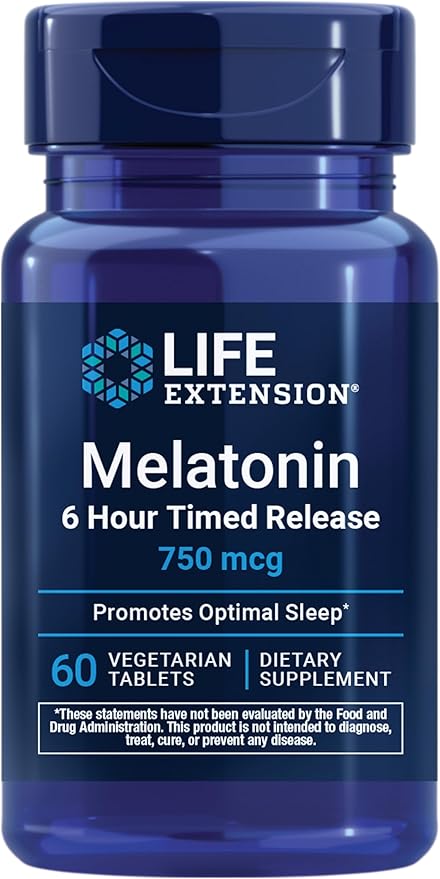
Life Extension Melatonin 300 mcg, 100 sublingual lozenges
Physiologic-dose (0.3 mg) melatonin sublingual lozenges. The Brzezinski-2005 dose; supermarket 5-10 mg products are pharmacologic and counterproductive.

Why We Sleep by Matthew Walker (paperback)
Walker's 2017 sleep-science book. We cite it across sleep articles with the Guzey-2019 critique caveat.
As an Amazon Associate, BiologicalX earns from qualifying purchases.