
Vitamin D is probably the most-supplemented nutrient with the thinnest justification in supplemented individuals. For actual deficiency, the benefit is real. For population-wide "just take it", the largest RCT we have was null on its primary endpoints.
What VITAL actually found

VITAL (Manson et al. 2019, NEJM, n=25,871) randomized US adults over age 50 (men) or 55 (women) to vitamin D3 2,000 IU/day or placebo for ~5 years. Primary endpoints: invasive cancer and major cardiovascular events. Result: no significant reduction in either ( Manson et al. (VITAL) 2019, n=25871 ). Secondary signals suggested a modest mortality benefit from cancer (~17% relative reduction at ~4 years of follow-up), and a benefit in people with low baseline BMI, but the headline primaries were flat.
D2d (Pittas 2019, NEJM, n=2,423) tested vitamin D3 4,000 IU/day in prediabetic adults. Null on progression to diabetes ( Pittas et al. (D2d) 2019, n=2423 ).
These are not "vitamin D doesn't matter" trials. They are "adding vitamin D to people who are not deficient does not help with these endpoints in these populations" trials. The nuance matters.
Who actually benefits from supplementation

Testing 25-OH vitamin D costs ~$30-70. Targets:
- Deficient (<20 ng/mL or <50 nmol/L): clear benefit from correction. Bone health, immune function, possibly mood. 4,000-6,000 IU/day until retested in 8 weeks.
- Insufficient (20-30 ng/mL): modest benefit from correction. 2,000-4,000 IU/day.
- Sufficient (30-60 ng/mL): no need to supplement. Ambient sun + diet are doing the job.
- High (60-80 ng/mL): not harmful, not especially helpful.
- Toxic (>100 ng/mL): calcium dysregulation. Stop supplementing.
Dosing math
The rule of thumb: 1,000 IU/day of D3 raises 25-OH by ~7-10 ng/mL over 8-12 weeks in an average adult, with significant inter-individual variability. Obese individuals often need 2-3x the dose because D3 partitions into adipose tissue.
| Phase | Dose | Frequency | Notes |
|---|---|---|---|
| Baseline <20 ng/mL | 4,000-6,000 IU D3 | daily with fat | Retest at 8 weeks, adjust down if over 60 ng/mL |
| Baseline 20-30 | 2,000-4,000 IU D3 | daily with fat | Retest at 12 weeks |
| Baseline 30-60 | 500-1,000 IU (or none) | daily | Maintenance only if climate/diet low in D |
| Baseline 60+ | Stop | - | Retest yearly to confirm |
Take with a fatty meal. D3 (cholecalciferol) is better absorbed than D2 (ergocalciferol) and produced endogenously from skin synthesis; D3 is the form to supplement.
Why K2 fits in
Vitamin D increases intestinal calcium absorption. Calcium then circulates; the question is whether it deposits in bone (good) or in arterial walls (bad). K2 (specifically the MK-7 form, menaquinone-7) activates matrix Gla protein, which inhibits arterial calcification, and osteocalcin, which drives calcium into bone matrix.
The strongest K2 RCT is Knapen 2015 Knapen et al. 2015, n=244 (3-year, n=244, postmenopausal women, 180 mcg MK-7/day), which showed reduced arterial stiffness and slowed bone loss. The cardiovascular literature beyond that is smaller and mixed.
Practical rule: if you're supplementing more than 2,000 IU D3/day chronically, add 100-200 mcg MK-7 K2/day. The incremental cost is small; the calcification-localization story is mechanistically sound; the downside is zero in healthy adults.
Exception: if you're on warfarin, do not add K2 without your prescribing clinician's sign-off. K2 is the same vitamin K family warfarin blocks.
The high-dose camp
Some practitioners (the "target 70-100 ng/mL" school) argue that human evolutionary baseline in sun-exposed populations sits at higher levels than modern indoor life produces, and that the "insufficient" threshold should be pushed up. The argument has intuitive pull; the RCT evidence for benefit above 60 ng/mL is thin. We'd rather err conservative until better data lands.
What the cardiovascular trials actually showed
The "vitamin D prevents heart attacks" claim has been a moving target for a decade. Manson 2019 (VITAL trial, n=25,871) is the largest primary-prevention RCT to date ( Manson et al. (VITAL) 2019, n=25871 ). Five years of 2,000 IU/day D3 versus placebo in adults with no cardiovascular disease at baseline. Primary endpoint (major cardiovascular events) was null.
The reconciliation:
- VITAL recruited adults at population-average baseline 25-OH D, around 31 ng/mL. Most participants were already replete. The trial tested supplementation in a population that didn't need supplementation.
- Subgroup analyses (Black Americans, low-baseline-D participants) showed signals worth flagging. The signal in the deficient subgroup is consistent with the deficiency-correction hypothesis the broader trial wasn't designed to test.
- The VITAL D-and-cancer outcome was small but directionally positive at long follow-up; the cardiovascular outcome remained null.
The honest framing: vitamin D supplementation does not prevent cardiovascular events in already-replete adults. It probably benefits truly deficient adults, but the trial evidence for deficiency-correction-equals-CVD-protection is mostly inferred from the cohort observational literature rather than RCT-validated.
The Pittas 2019 D2d trial (n=2,423, prediabetics) tested 4,000 IU/day for 2.5 years and found no significant reduction in progression to type 2 diabetes ( Pittas et al. (D2d) 2019, n=2423 ). Same pattern: vitamin D in already-sufficient adults does not produce metabolic benefit. Deficiency correction in deficient adults is a different question the trial didn't isolate.
Skin synthesis vs supplementation
Endogenous vitamin D production via skin sun exposure remains the species-default pathway. Modern indoor life shortens sun exposure dramatically; supplementation is the bridge.
The math: 15-30 minutes of midday summer sun on bare arms and face for a fair-skinned adult produces roughly 10,000-20,000 IU equivalent. Most adults at 40+ degrees latitude get insufficient sun exposure October-April to maintain repletion regardless of summer behavior.
The skin-synthesis vs supplementation trade-off:
- Skin synthesis advantages: produces vitamin D plus other photoproducts (some of which may have independent effects), no GI absorption variability, naturally self-limiting (skin synthesis plateaus before producing toxic levels).
- Skin synthesis disadvantages: melanoma risk from prolonged unprotected sun exposure, latitude-dependent insufficiency in winter months, age-related decline in skin synthesis efficiency (a 70-year-old produces about a quarter as much vitamin D as a 20-year-old at matched sun exposure).
The pragmatic split: prioritize 10-15 minutes daily incidental sun exposure (not midday, not unprotected for hours), supplement to fill the seasonal gap, test annually to verify the strategy is working.
Magnesium and the vitamin D cofactor
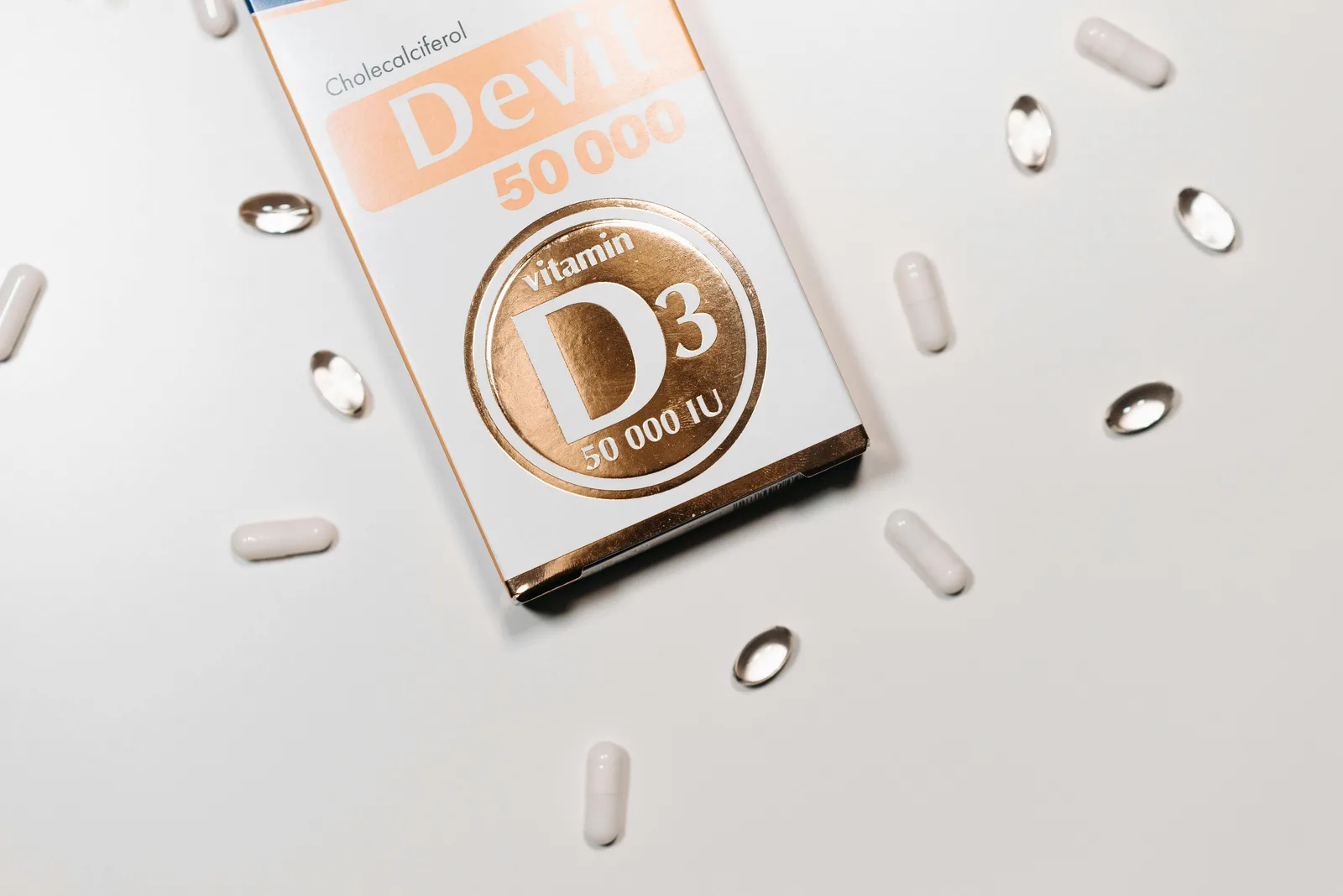
Vitamin D activation requires magnesium as a cofactor at multiple steps. The 25-hydroxylase enzyme that converts D3 to 25-OH D is magnesium-dependent. The 1-alpha-hydroxylase that converts 25-OH D to active 1,25-(OH)2 D is also magnesium-dependent.
The implication: chronically magnesium-depleted adults can take large doses of D3 and fail to elevate active 1,25-(OH)2 D, because the activation enzymes are rate-limited. The "I take 5,000 IU and my levels haven't moved" pattern often resolves when magnesium repletion happens first.
The practical workflow:
- Test serum 25-OH D and serum magnesium together.
- If both are low, correct magnesium first (or in parallel) using magnesium glycinate 200-400 mg/day.
- Re-test 25-OH D at 8-12 weeks; with adequate magnesium, the same D3 dose produces a larger movement.
Most vitamin D supplements don't include magnesium, which is one of the gaps in over-the-counter formulations. The sleep-stack magnesium glycinate (200-400 mg with dinner) doubles as the vitamin D activation cofactor without additional supplementation.
When to test
Annual is the operational cadence for most adults. The exception is during the active correction phase:
- Active deficiency correction (baseline under 20 ng/mL): retest at 8 weeks, adjust dose, retest at 12-16 weeks to confirm steady state.
- Steady-state monitoring (in target band): annual retest, ideally late winter (when levels are seasonally lowest) so the test catches insufficiency rather than missing it during summer high.
- High-dose monitoring (above 4,000 IU/day): every 6 months. Vitamin D toxicity is rare at typical supplementation doses but real at sustained 10,000+ IU/day for months.
The annual late-winter test is the most informative single data point. Most adults' levels swing 10-15 ng/mL between summer peak and late-winter trough. Testing in February-March catches the trough; testing in August catches the peak. The trough is what matters for setting the supplementation strategy.
Counter-view
Michael Holick is the primary advocate for higher targets and broader supplementation; the VITAL team (JoAnn Manson in particular) argues the trial data does not justify broad supplementation in sufficient individuals. Both are looking at the same data with different priors. The conservative reading is VITAL's: correct deficiency, don't overshoot, test to know.