
Calories count; timing shifts them slightly. The circadian glucose data is clean enough to justify a modest but practical rule: eat earlier when you can, and stop earlier.
What the biology does

Insulin sensitivity follows a circadian rhythm anchored by the SCN and peripheral clocks in liver, pancreas, and muscle. Sensitivity is highest 1-3 hours after waking and declines through the day, bottoming 4-6 hours before habitual sleep time.
Practical implication: the same meal produces a higher glucose excursion at 9pm than at 9am. The liver is less ready to absorb glucose; muscle glycogen storage runs slower; pancreatic beta cells have already worked all day.
The Jakubowicz trial
Jakubowicz 2013 (Obesity, n=74, 12 weeks) randomized overweight women to two isocaloric 1,400 kcal/day diets ( Jakubowicz et al. 2013, n=74 ):
- Big breakfast group: 700 kcal breakfast, 500 kcal lunch, 200 kcal dinner.
- Big dinner group: 200 kcal breakfast, 500 kcal lunch, 700 kcal dinner.
Results:
- Big breakfast group: -8.7 kg.
- Big dinner group: -3.6 kg.
- Fasting glucose, insulin, and insulin resistance (HOMA-IR) improved more in big-breakfast group.
Small trial. Replicated directionally in subsequent studies. The effect is real but modest; macronutrient composition and adherence explain more of the variance than pure timing.
Time-restricted eating trials support the same direction: Cienfuegos 2020 (n=58) showed 4-hour and 6-hour TRE windows produced modest weight loss and improved insulin sensitivity vs control ( Cienfuegos et al. 2020, n=58 ). The benefit tracks with adherence more than with the specific timing window.
Practical framework
| Phase | Dose | Notes |
|---|---|---|
| Anchor wake time | Same ±30 min daily | Foundation of all circadian work |
| First meal | Within 1-3 hours of waking | Protein-forward (30-40 g). Sets peripheral clock. |
| Largest meal of the day | Lunch, 5-6 hours after waking | Peak digestive capacity |
| Last meal | 3+ hours before bed | Stops before insulin sensitivity bottom |
| Eating window | 10-14 hours | Wider = more social flexibility; narrower = stricter circadian alignment |
| Snacks | Minimal between meals | Constant grazing blunts the fasted periods that drive some of the benefit |
The "skip breakfast" debate
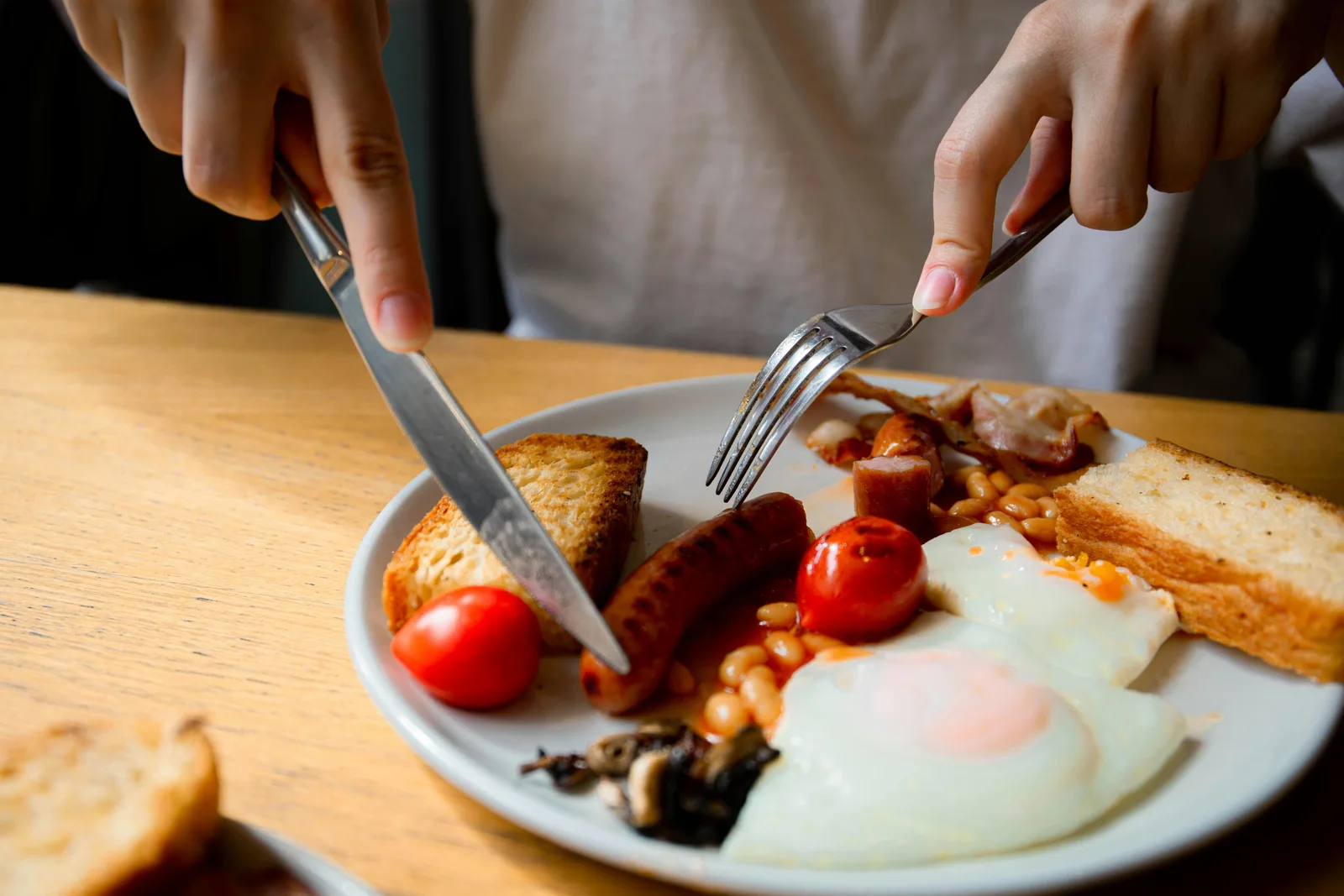
- If you're hitting protein + calorie targets: skipping breakfast is fine. TRE 16:8 with the eating window 12pm-8pm is viable.
- If you skip breakfast and eat a large late dinner: this is the worst pattern in the chrononutrition data. Late eating + extended fast + reduced insulin sensitivity compound.
- If you lift in the morning: break your fast with 25-40 g protein within 1-2 hours post-workout for MPS optimization.
Nocturnal eating specifically
Eating within 3 hours of bed degrades sleep quality in controlled trials. Mechanisms: digestive thermogenesis opposes the core body temperature drop needed for sleep onset; nocturnal glucose rises; reflux worsens.
Evidence for the effect is strongest for larger meals; small amounts of protein (20 g casein before bed) don't seem to carry the same cost and may support overnight muscle protein synthesis for lifters.
When timing matters less
- Elite athletes in high-volume training: total calorie + macro targets dominate timing considerations.
- Night shift workers: can't align to the default circadian pattern. Personalized chrononutrition.
- High BMI rapid weight loss phase: calorie deficit dominates; timing is secondary optimization.
The clock genes and why timing matters at all
The mechanistic basis for chrononutrition is the peripheral circadian clock system. Most adults associate "circadian rhythm" with the brain's suprachiasmatic nucleus (SCN), but every metabolic organ has its own clock genes that respond to feeding signals more than to light:
Liver clock. The hepatic CLOCK/BMAL1 transcription complex oscillates with peak activity at the start of the active feeding window. Feeding entrains it; light does not directly entrain liver clocks. Disrupted hepatic rhythm impairs glucose homeostasis, lipid metabolism, and bile acid signaling.
Muscle clock. Skeletal muscle has its own clock that controls insulin sensitivity, glucose uptake capacity, and protein turnover. The muscle clock is most insulin-sensitive in the early-to-mid afternoon, which is one of the mechanistic bases for the "lunch is the largest meal" recommendation.
Adipose clock. Adipose tissue clock controls leptin secretion, lipolysis rhythms, and adipogenesis. Disrupted adipose rhythm via late eating contributes to the late-eating-equals-weight-gain epidemiology.
Gut microbiome rhythm. Many gut bacteria oscillate in abundance and metabolic activity across the day. Feeding patterns modulate which microbes flourish and when. Late-night eating selects for different microbial communities than early-day eating.
The peripheral clocks are entrained primarily by feeding signals. The SCN sets the master clock via light; the peripheral clocks set themselves via meal timing. When the two are misaligned (light-dark cycle says morning, but feeding says midnight), the resulting circadian disruption is the metabolic problem chrononutrition is trying to address.
Shift work and split chronotypes
Two populations cannot follow the standard chrononutrition recommendations and need their own framing:
Night shift workers. The light-cycle entrainment pulls one direction, the social schedule pulls another. The cleanest evidence-supported approach for night shift is to maintain the inverted schedule consistently (sleep during the day with full blackout, eat the largest meal early in the night shift, light exposure during the entire shift) rather than oscillating between night-shift and day-shift patterns on days off. The population epidemiology (Vetter 2018 and similar) suggests rotating shift work is far more metabolically harmful than fixed shift work, and that holding the same schedule on rest days approaches the metabolic profile of standard daytime workers.
Late chronotypes (genuine night owls). The 8 am-6 pm eating window is brutal for genetic late chronotypes whose biological midnight is closer to 4 am. The evidence-supported adjustment is to shift the entire eating window later in line with the chronotype's biological clock (10 am-8 pm or 11 am-9 pm), maintaining consistency rather than fighting the biology. Forcing genuine late chronotypes into early eating windows produces social jet lag and worse outcomes than honoring the chronotype.
The practical handle: chronotype is not the same as habit. Most "I'm a night owl" claims are actually social-jet-lag patterns from late-evening screen exposure, not genuine biological late chronotypes. The honest test: a 14-day vacation with no alarms and no evening screens. The natural sleep-wake pattern that emerges is your real chronotype.
Pre-sleep eating: the underappreciated trade-off
The "no eating within 3 hours of bed" rule is well-supported on average but has a specific exception worth flagging: protein in small amounts pre-sleep does not carry the same cost as a full meal pre-sleep, and may support overnight muscle protein synthesis for lifters.
Snijders 2015 and follow-up casein-pre-sleep trials in resistance-trained men found that 30-40 g casein protein 30 minutes before bed elevated overnight muscle protein synthesis without impairing sleep architecture. The mechanism is straightforward: casein is a slow-digesting protein that produces a sustained amino acid release over 6-8 hours, supporting overnight MPS during a period when the muscle would otherwise be in net negative protein balance.
The trade-off:
- Small protein dose (≤40 g, low fat, low carb): sleep architecture preserved, overnight MPS supported. Compatible with fitness goals.
- Larger meal (full dinner with carbohydrates and fat): digestive thermogenesis opposes core temperature drop, glucose rise interferes with melatonin onset, sleep architecture degrades. Avoid.
For lifters specifically chasing hypertrophy, the casein-pre-sleep protocol is one of the better-evidenced timing-specific recommendations. For everyone else, the standard "stop eating 3 hours before bed" rule applies.
Counter-view
Satchin Panda and Krista Varady argue meal timing is a larger lever than Jakubowicz's effect size suggests. Kevin Hall's camp points to Lowe 2020 Lowe et al. 2020, n=116 and matched-calorie trials showing smaller independent effects of timing beyond what the total-calorie math predicts. The resolution is Jakubowicz-modest: timing helps, but not enough to overcome macro-nutrient + calorie decisions.