Most people don't train because they don't have time. The empirical answer is that the time floor is lower than the fitness industry suggests. Two 30-45 minute full-body sessions per week produces most of the strength and hypertrophy gains that four-session programs produce, especially for untrained and intermediate lifters.
What the meta-analyses converged on

Schoenfeld 2017 (n=34 RCTs, Journal of Sports Sciences) analyzed weekly volume vs hypertrophy ( Schoenfeld et al. 2016 ). Findings:
- Dose-response: more weekly volume produced more hypertrophy up through ~10 sets per muscle group per week.
- Past ~10 sets: diminishing returns, with individual variance.
- Some studies showed continued gains up to 20 sets; beyond 20 sets was uncommon in the analyzed trials.
Grgic 2018 (Sports Medicine meta) analyzed frequency ( Grgic et al. 2018 ): when weekly volume is matched, training each muscle 2x/week vs 1x/week produced similar strength gains. Hypertrophy showed a slight edge to 2x/week but the effect size was small.
Paoli 2024 (Sports Medicine Open) reviewed the minimum-effective-dose literature ( Paoli et al. 2024 ): as little as 30-60 min/week of properly programmed resistance training can preserve substantial portions of strength and lean mass in the untrained-to-intermediate lifter.
Volume, frequency, and minimum dose: what the meta-analyses agree and disagree on
| Study | N | Duration | Design | Outcome | Finding |
|---|---|---|---|---|---|
| Schoenfeld 2017 (volume) cite | pooled across 34 RCTs | trial range 6-12 wk | meta-analysis of weekly per-muscle volume | Hypertrophy | Dose-response up to ~10 sets/muscle/week; further gains up to 20 sets in some trials, with diminishing returns |
| Grgic 2018 (frequency) cite | pooled across 22 studies | trial range 6-26 wk | meta-analysis of training frequency at matched volume | 1RM strength | When weekly volume is matched, 2x vs 1x frequency produced similar strength; small hypertrophy edge for higher frequency |
| Paoli 2024 review cite | narrative synthesis | n/a (review) | minimum-effective-dose literature review | Strength and lean mass retention | 30-60 min/week of properly programmed work preserves most gains in untrained-to-intermediate lifters |
Synthesis The three reviews triangulate to a coherent prescription: volume drives most hypertrophy up to ~10 sets per muscle per week, frequency is interchangeable at matched volume, and the practical floor is 30-60 weekly minutes of work for general-population lifters.
The minimum protocol
| Phase | Dose | Frequency | Notes |
|---|---|---|---|
| Squat or hinge | 2-3 sets of 5-8 reps | each session | Alternate squat and deadlift days if possible |
| Push (vertical or horizontal) | 2-3 sets of 6-10 reps | each session | Overhead press + bench press across the week |
| Pull (vertical or horizontal) | 2-3 sets of 6-10 reps | each session | Pull-up/chin-up + row across the week |
| Core or accessory | 1-2 sets of 10-15 reps | each session | Plank, carry, or hanging leg raise |
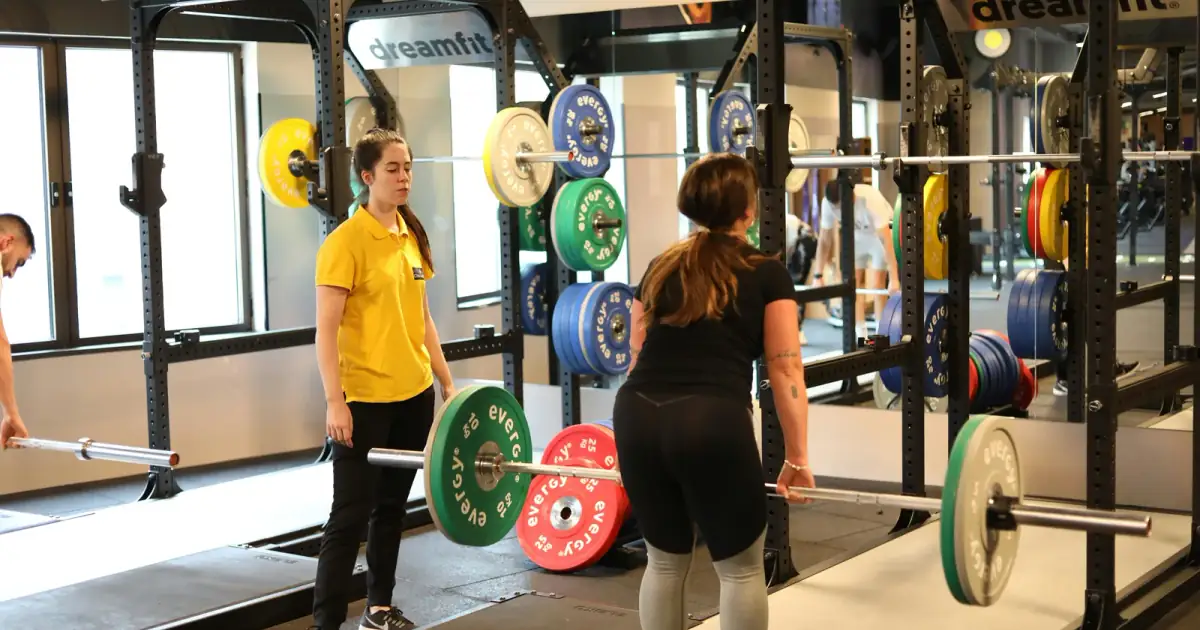
| Total time | 30-45 min per session | 2x/week | Warm-up + main lifts + short accessory |
Rest 2-3 minutes between working sets on compound lifts. 60-90 seconds on accessories. Progress load when you hit the top of the rep range with 2-3 reps in reserve.
Proximity to failure matters more than load
Morton et al. 2016 Morton et al. 2017, n=1863 and subsequent work have shown that hypertrophy outcomes are similar across wide load ranges (~30% 1RM to ~90% 1RM) as long as sets are taken close to momentary failure (within 2-3 reps). Older programming heuristics prescribed specific load percentages; modern programming is more outcome-oriented: pick a load you can do for 5-15 reps, go within 2-3 reps of failure, adjust load when that rep count becomes too easy.
For strength specifically (not just hypertrophy), loads in the 75-90% 1RM range (4-8 reps) are more efficient; powerlifters specialize there for neural adaptation and technical practice at competition-relevant loads.
Who this ISN'T enough for
- Competitive physique athletes. Bodybuilders and figure competitors need volumes closer to 15-25 sets per muscle per week.
- Competitive strength athletes (powerlifting, Olympic weightlifting) need higher frequency on the specific competition lifts for technical practice, not just muscle-stimulus.
- Advanced intermediates trying to add 10+ kg to their major lifts per year. The "minimum" compounds diminishing returns past ~2 years of consistent training.
If you are not in one of those categories, 2 sessions/week of 30-45 minutes will give you 80-90% of the achievable benefit and will be easier to adhere to than a 4-6 session program.
Older adults (60+)
The minimum-effective-dose for preserving muscle and function past 60 is slightly higher. 2-3 sessions/week, emphasize power production in addition to strength, and add balance work. Explosive intent (lifting the concentric phase as fast as you can control) produces power-specific neural adaptations that standard slow-controlled training does not.
The counter-view
Mike Israetel and Brad Schoenfeld camps argue that if hypertrophy is the goal, the volumes cited here undershoot. They are right for advanced hypertrophy athletes. For a general healthspan-focused adult who lifts 2x/week, they are optimizing for the wrong ceiling. Stuart McGill is more conservative on squat/deadlift loading for populations with preexisting spinal issues; his programming substitutes (goblet squat, Zercher, trap bar) are legitimate alternatives.