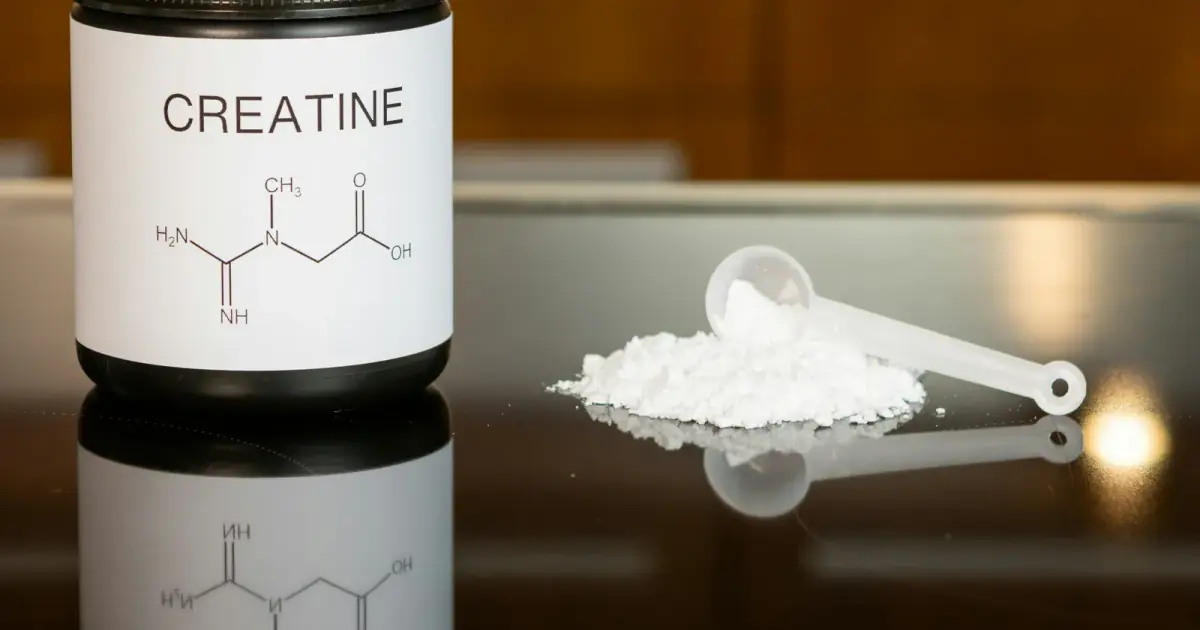
Creatine monohydrate is the most-replicated supplement in human research. The protocol is settled, the safety record is clean, and the questions readers ask are mostly variants of "can I optimize this further?" The honest answer is mostly no. This guide walks through the few choices that matter and the many that don't.
The validated protocol: 5 g/day, indefinitely
Five grams of creatine monohydrate per day, taken with any meal, continued indefinitely. That is the entire core protocol. The Kreider 2017 ISSN position stand summarizes the evidence base across hundreds of trials at this dose Kreider et al. 2017 .
At 5 g/day, muscle creatine stores reach saturation in about 28 days. From that point, daily intake replaces what the body excretes (creatinine, the natural breakdown product). The pool stays full as long as the supplementation continues; it returns to baseline over 4-6 weeks if you stop.
Body size matters slightly. Larger people have larger total creatine pools and slightly higher daily turnover. A defensible scaling is roughly 0.03 g/kg/day, which lands a 100 kg lifter at 3 g/day and a 60 kg endurance athlete at closer to 2 g/day. The 5 g/day standard is a reasonable upper bound that covers most adult body sizes; doses above 5 g/day in well-saturated users have no demonstrated benefit and slightly increase GI side-effect risk.
Loading: optional, accelerates the timeline
The optional loading phase is 20 g/day split into 4 doses of 5 g for 5-7 days, after which the user transitions to the 5 g/day maintenance dose. Loading reaches saturation in roughly a week instead of the four weeks required at 5 g/day plateau.
The trade-offs:
- Loading is harmless at trial-validated doses across decades of use.
- Loading accelerates the timeline by ~3 weeks, which is meaningful for short training blocks (12-week competitive prep, in-season athletes).
- Loading has higher GI side-effect risk (mild bloating, occasional diarrhea); splitting the dose across 4 servings and pairing each with a meal essentially eliminates the issue.
- Skipping loading costs 3 weeks to reach the same plateau.
For most users, skipping loading and starting at 5 g/day is the lower-friction protocol. For users on a tight training-block timeline (preparing for a competition, optimizing in-season performance), loading is reasonable.
Either approach reaches the same steady-state. There is no incremental long-term benefit to loading.
Timing: barely matters
The timing question is the most-asked and the lowest-stakes question in creatine dosing.
Within the day: morning vs evening produces no meaningful difference once muscle stores are saturated. The acute pharmacokinetics (peak in 1-2 hours, return to baseline in 6-8 hours) are irrelevant when the muscle pool is the storage compartment, and the muscle pool turns over on weeks-to-months timescales.
Pre vs post-workout: post-workout dosing has a modest theoretical edge from insulin's effect on the SLC6A8 transporter (10-20% better retention with carbohydrate-and-protein meal), but the effect is small enough that it gets washed out by individual variation. A few trials have tested pre-vs-post-workout directly with negligible differences in outcomes.
With or without food: with food is the conventional pattern for adherence reasons (people remember to take it with meals) and the modest absorption boost from insulin. Without food works equally well for retention once saturation is reached.
The defensible heuristic: take it post-workout with your post-workout meal on training days, and with breakfast on rest days. Mostly because it's a habit that's hard to forget. The actual within-day timing barely matters.
Form: monohydrate beats everything else
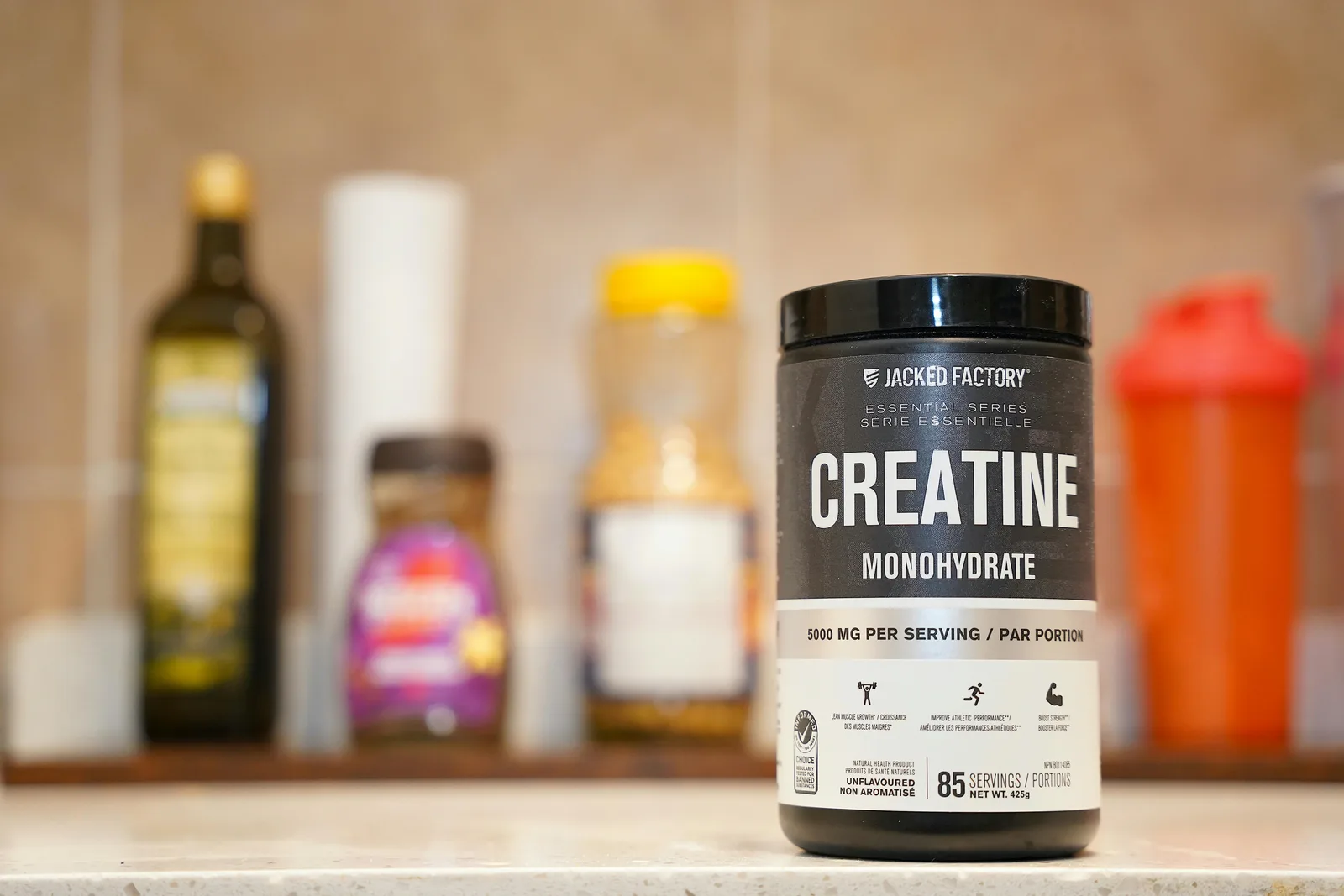
Buy plain creatine monohydrate. The form question has been litigated:
- Micronized creatine monohydrate: dissolves more cleanly; not bioavailability-enhanced. Same effect as standard.
- Buffered creatine (Kre-Alkalyn): marketed as "stomach-pH-resistant"; head-to-head trials show parity or inferiority.
- Creatine HCl: marketed for "better absorption"; head-to-head trials show parity at equivalent doses.
- Creatine ethyl ester: head-to-head trials show inferiority.
- Creatine nitrate, magnesium creatine chelate, etc.: niche forms with weak evidence and higher cost.
The Kreider 2003 long-term safety review covers the monohydrate evidence base across multiple-year studies Kreider, Melton, Rasmussen, Greenwood, Lancaster, Cantler, Milnor & Almada 2003, n=98 . Other forms have not accumulated comparable evidence.
The Creapure brand (German-manufactured, third-party-verified) is the lowest-friction sourcing decision. Generic monohydrate from a tested brand is fine; quality variation is small.
Storage and preparation
Dry creatine powder is stable for years at room temperature. Once dissolved in water, it slowly degrades to creatinine; do not pre-mix shakes the night before. A scoop in your shaker minutes before drinking is fine.
Cold water dissolves slightly worse than warm water; both work. Sugar or carbohydrate co-administration modestly increases retention via insulin (real but small effect).
What you don't need to worry about
- The brand (within tested products): generic monohydrate is fine; Creapure is a slightly safer sourcing choice
- The exact gram count: 4-6 g/day all work; pick something convenient and stick with it
- The timing within the day: any consistent meal works
- Cycling: you don't need to cycle off
- Hydration loading: drink to thirst; the once-popular "extra water" recommendation is not evidence-supported
- Stacking with caffeine: older studies suggested an interference effect at acute high caffeine doses; chronic moderate caffeine + chronic creatine combine without issues
Side effects to monitor
The most common reported issue is mild GI upset, almost always associated with loading doses or with poor-quality powders that fail to dissolve. Splitting the loading dose across four servings and pairing each with a meal essentially eliminates the issue.
The 1-2 kg of intracellular water gain is not a side effect; it is the mechanism. Some users report it as bloating, but it is intramuscular water rather than subcutaneous water and produces fuller-looking muscles, not puffiness.
Serum creatinine elevation of 0.1-0.3 mg/dL is expected. In clinical settings this can cause spurious flags on routine bloodwork or eGFR calculations. The fix is either measuring cystatin C-based eGFR or pausing creatine for 4-6 weeks before testing kidney function. Long-term studies in healthy adults out to 5 years have not detected renal impairment.
The standing recommendation in pre-existing severe renal disease is to consult a nephrologist before starting. Otherwise, creatine has one of the cleanest safety records in the supplement space.
When to expect changes
- Strength and lean-mass effects: 2-4 weeks for early signs; cumulative effects compound across training cycles (months to years).
- The 1-2 kg intracellular water gain: visible by week 2-4.
- Cognitive effects (under sleep deprivation or vegetarian baseline): variable; some users report subtle effects within weeks, others see nothing.
- Subjective energy / training output: 2-4 weeks for users who weren't already saturated through diet.
If you have not seen any change by 8 weeks of consistent training and dosing, the limiting factor is almost certainly training volume or sleep, not the supplement.
See also
- Creatine living review for the comprehensive evidence map
- Creatine compound profile for the schema-level detail
- Resistance training minimum effective dose for the training context that creatine supports
- Protocol experiment: creatine + cognition for the cognitive-use case detail